
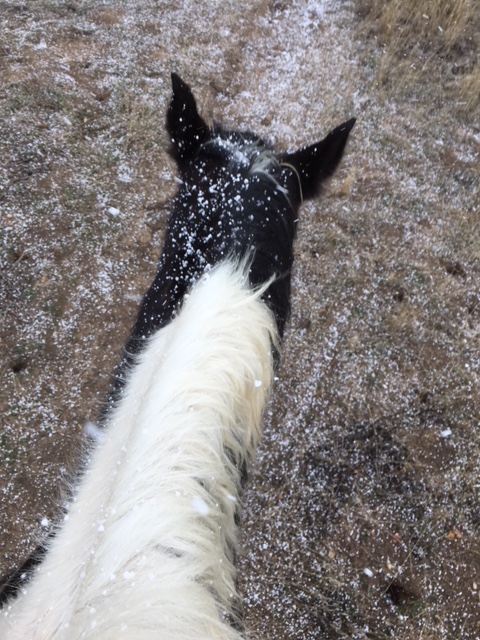
On my daily horse ride on the PCT north from my place this morning, I happened to cross paths with the first northbound thru hiker of 2018 — an older gentleman looking for the solitude that the PCT used to offer thru hikers, who was taking advantage of the very low snow conditions on San Jacinto, San Gorgonio, and the Sierra. (Of course, conditions may change.) Apart from the two guys who hiked the trail southbound during the winter of ’14-’15, this is the earliest I have seen anyone seriously attempt a thru hike. — I wish him luck. Hiking conditions in my area are ideal right now and the trail is nearly deserted.
Category: Uncategorized
Trail work on Spitler Peak/PCT re-route
Our fearless Section Chief Don led thirteen volunteers on a trail work day on the Spitler Peak Access Trail (temporarily, part of the PCT re-route around the small remaining Mountain Fire closure south of Idyllwild). On the one hand, passing through a fire area is sad, because you can see the damage that was done (and is still evident 3.5 years later). But, slowly, the vegetation is coming back.


Sad find in Alkali Wash off PCT
I had two friends up for the weekend and we decided for an off-trail hike down Alkali Wash (from PCT mile 148). With the recent rain, there were lots of tracks, including what appeared to be two pair of coyotes heading down canyon. We can upon an area with a lot of coyote activity, and my friend surmised that the coyotes were “playing.” Alas, that doesn’t appear to be what the coyotes were up to.
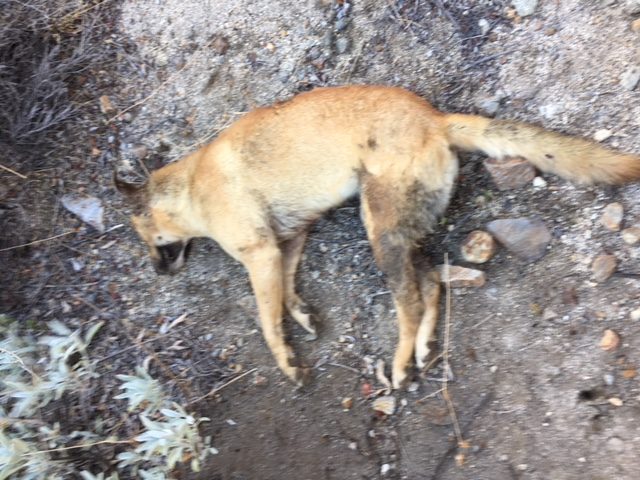
At first we thought it was a female coyote, but neither the coat nor the head were quite right, so we surmise it was a domestic dog or a coydog. Whatever it was, it hadn’t been dead for very long.
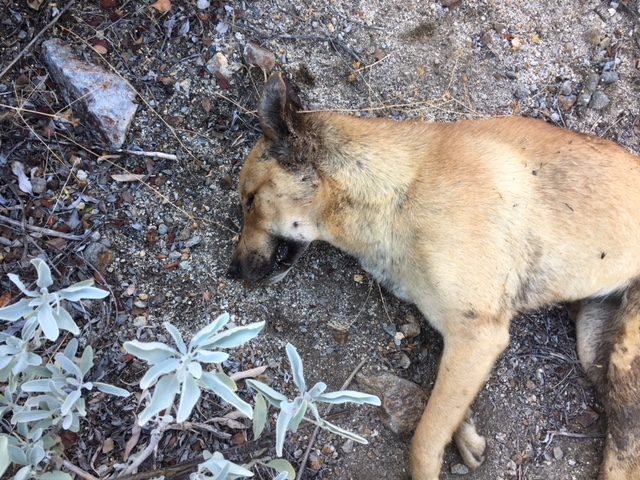
We were all surprised that the coyotes that killed it hadn’t fed on it. (Or, perhaps our arrival had interrupted them before they had a chance to.) On our trip back up canyon, we saw very fresh (as in, since we passed by on the outbound leg) coyote prints in the wet sand. It appeared to the the same pair that had left prints going down canyon that we had seen earlier.
Prepping for 2018 – part 2
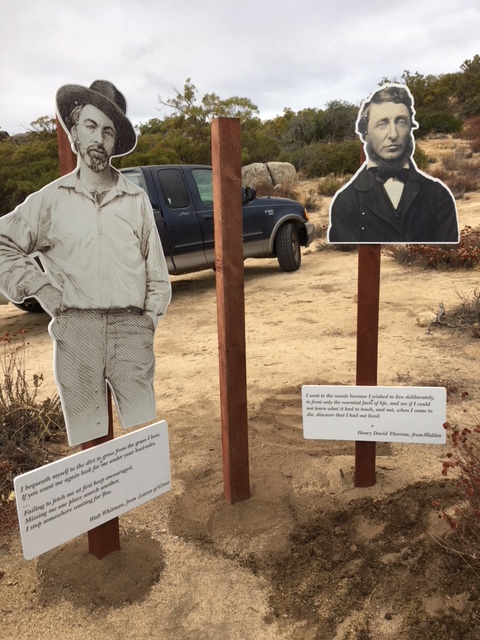
I’m starting the process of changing my hiker oasis from ‘Walden’ to ‘Muir Wood(S)’ for 2018 with the installation of a new post for Mr. Muir.
Trail Work and Short Backpack Trip to Live Oak Spring
Over the Thanksgiving holiday weekend, I did some trail work with the “Paradise” section trail crew just north of Warner Springs along Agua Caliente creek (which was running for part of the way).
On Sunday and Monday, I did a short backpack to Live Oak Spring, about a mile off the PCT just north of Hwy 74.
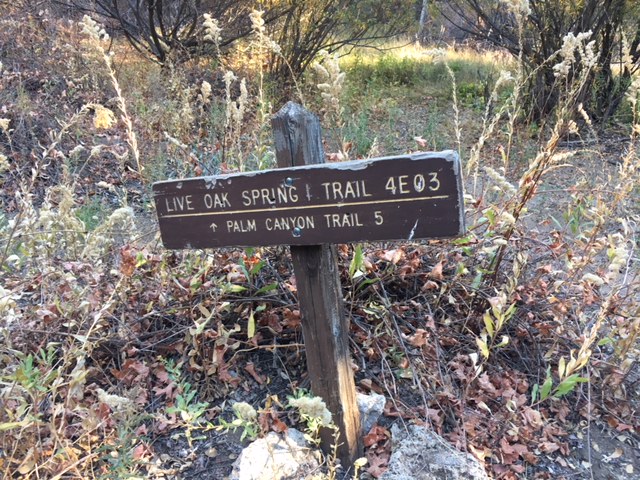
I camped among the giant live oaks that give the area its name and enjoyed some quiet time.

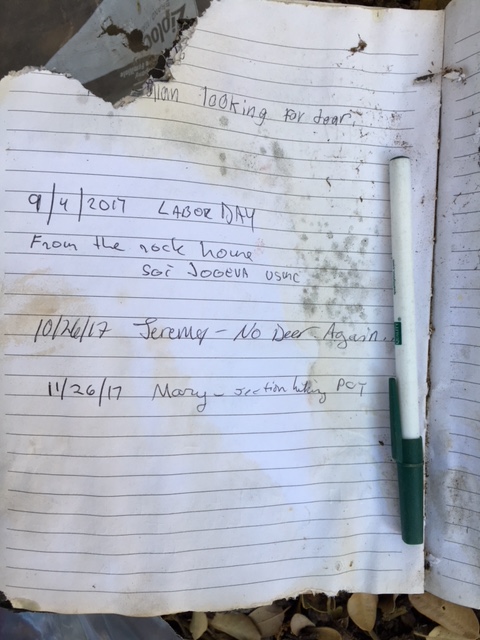
The camp register has been seriously chewed by mice, but you can still make out the visitors for the past several months. It is odd that Jeremy reports “no deer again” since I could see deer tracks and deer scat all over the ground, as the deer take advantage of the massive number of acorns lying all over the ground.
This is why we do it 2
I got a lovely surprise when I went to visit Walden on Saturday morning: a hiker with the trail name Slug (who blogs at slugpace.com) paid a visit to my place and left a beautiful hand-painted watercolor postcard.


An image on Slug’s instagram feed shows that he painted several similar postcards while at my place. Pretty, cool, huh?
Slug, if you stumble upon this post from the pingback, sorry I missed you. We have a lot in common.
A busy weekend on the PCT
This weekend, I counted 16(!) hikers on the section of the PCT that passes by my place: 8 in two sets of four section hikers, with the remainder sobo thru hikers. It’s not quite the numbers in the spring deluge of northbound hikers, but I’ve never seen this many on the trail in late October before.
A rolling stone visits my Little Free Library
… no, not that type of rolling stone.
This weekend, I found a rock left in my little free library.
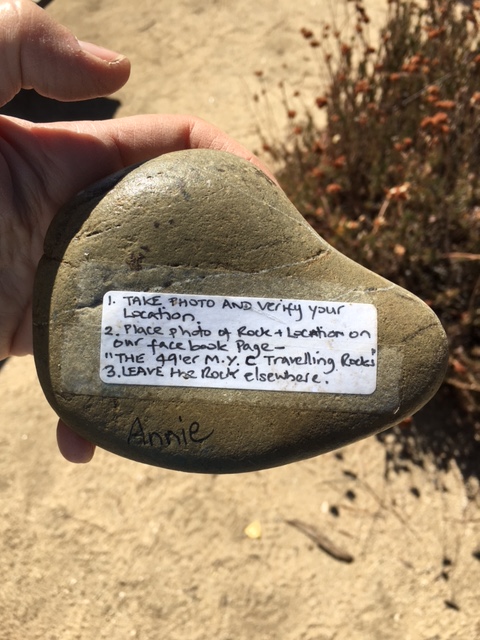 I don’t do Facebook, so I will leave it to someone else to document its travels to/from my place.
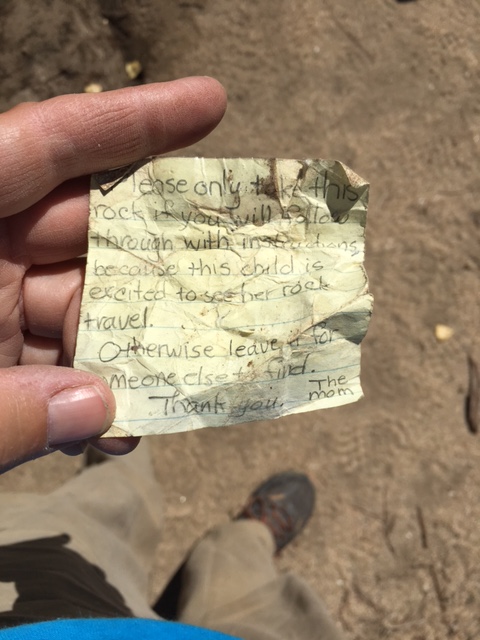
Under the rock was a crinkled up sticky note with more info:
 |
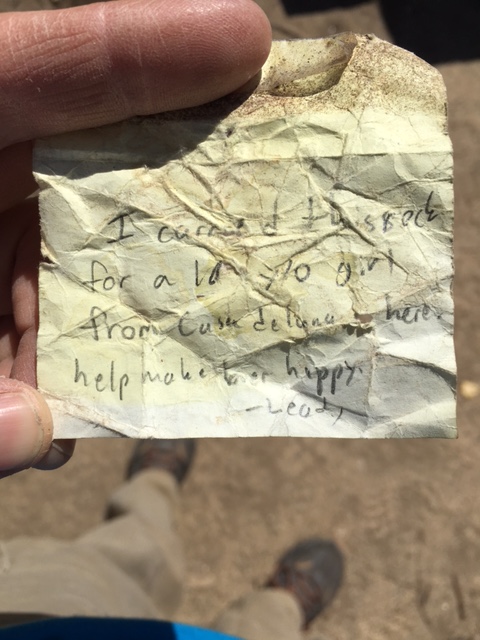 |
Hopefully, some hiker will pick it up and carry it on.
UPDATE: When I checked the Little Free Library on October 28, the rock and note were gone, so I suspect it was picked up by a hiker and carried further south on the PCT.
Dealing with the Increased Traffic on the PCT
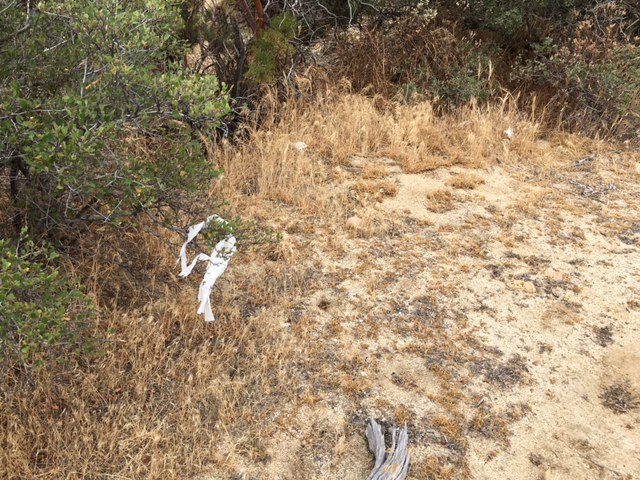
Like (I assume) all PCTA members, I received a letter from the organization this past week discussing their concern that increased use of the PCT has caused environmental degradation at popular camping sites near the trail and unsightly “traces” that some hikers leave behind that lessen the trail experience for those who come after them. [Toilet paper is most often cited as the undesirable trace, but other “traces” include trampled vegetation, unnaturally-cleared areas, remnants of camp fires, etc.] On my daily ride on Sunday morning, I photographed this “trace” in a popular tenting site just 10 feet off the trail around mile 147.
People in my position relative to the trail (ie, staying in the same place and watching as the trail changes from day to day as the herd of northbound hikers move through) have a unique perspective on the problem. 2017 has seen the largest northbound hiker herd in the history of the PCT, and, based on my experience, is also the year with the largest number of “traces” that are visible along the trail as the thru hiker season winds down.
One of the reasons that I allow camping at Walden is to lessen the burden that hikers place on popular sites nearby — particularly those mentioned in the various PCT guidebooks and apps as being good places to camp. As an example, consider the area the locals call “Big Rocks” at PCT mile 144, mentioned on Halfmile’s app as CS0144. According the Halfmile, CS0144 offers “several campsites among huge boulders.” During the height of last year’s hiker season, there would be upwards of twenty tents tightly packed among the boulders, as the still-novice hikers were very reliant on guidance from others, especially PCT apps, to help them navigate the trail and figure out where to do what from day to day. As a result of all this human activity, all the vegetation among the boulders is gone, and much of the surrounding area is riddled with “game trails” created as hikers leave the tenting areas to find a place to defecate. While the boulders are still magnificent, I wouldn’t want to camp there. At Walden, I have intentionally cleared a large, flat area of vegetation and added trash cans to prevent litter. On an average evening during the height of the thru hiker season in 2017, I had more tents at my place than Big Rocks, thanks in part to the fact that some early-season hikers highlighted Walden on Facebook, and noted that, unlike Big Rocks, Walden has water. My take-away from this is that, if hikers are informed of their presence, many of them will prefer to camp in a location with amenities over a location without amenities, but with more natural beauty and more “wilderness feel.” In southern California, the most sought-after amenity is water.
One possible way of addressing the issue of overuse and environmental degradation at the few natural water sources along the PCT in SoCal is to set up a series of regularly-spaced artificial water sources in less sensitive areas and suggest to hikers that they camp there. Much like the lean-tos along the AT concentrate camping (and the corresponding environmental damage) to small areas, these proposed supported camping areas along the PCT would serve the same purpose in arid, already-developed stretches of the PCT in southern California. I know that people at the PCTA will not like to hear this, but this sounds an awful lot like what the current cadre of water caches do. (Read up on PCTA’s thoughts on water caches and the response from many Class of 2015 thru hikers here.) Despite the PCTA’s public dislike of water caches, in their letter from last week, they propose creating preferred camping areas as one option to deal with environmental degradation caused by overuse in some sensitive areas. My experiment with Walden shows that, if the preferred camping area has the amenities hikers are looking for (relative to the environment they are moving through), the majority of them will stay at the preferred camping area, even if it is less “natural” than many surrounding areas. No coercion in the form of new rules about where to camp is required.
Luckily, I am not in a position to make policy or to direct the limited resources of the PCTA, so I can offer suggestions with little concern for repercussion. I admit to never having thru hiked (or, in my case, thru ridden) any piece of the PCT, but I have ridden the 10-mile stretch near me at least 265 times, so I have some experience to draw from, both about the problem and about a possible solution, at least as it applies to this and similar sections of the PCT.
 PCT 145 Trail Angel Mary